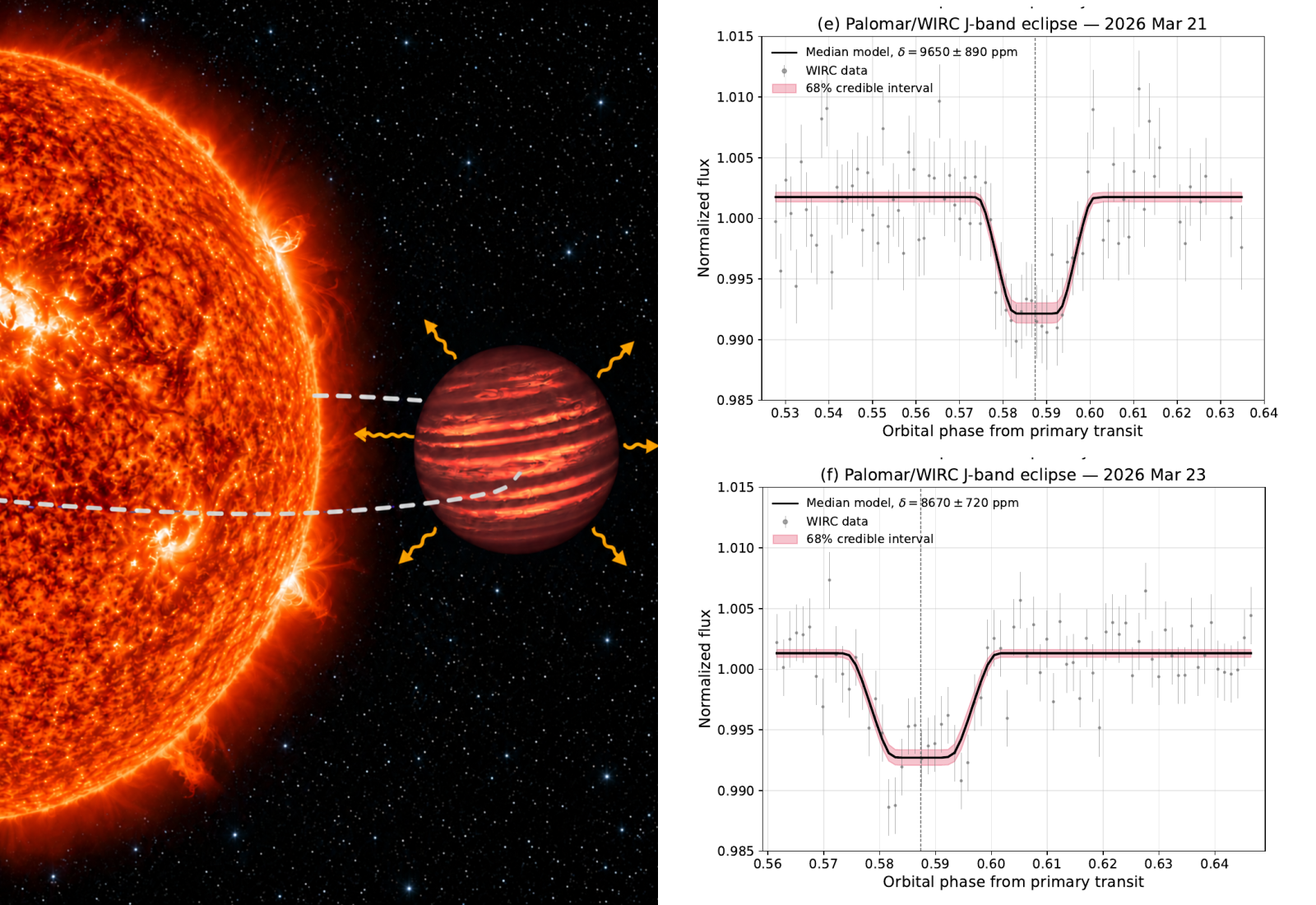
Under the mentorship of Dr. Steven Giacalone, I studied two transiting brown dwarfs, LP 261-75C and AD 3116B, using the 200-inch Hale Telescope at Caltech's Palomar Observatory. Brown dwarfs bridge the mass range between planets and stars. They can orbit stars just like planets, but with masses of roughly 13–80 Jupiter masses, they cannot sustain hydrogen fusion. LP 261-75C and AD 3116B both orbit their stars about every two days and are about 20% as massive as their host stars.
A primary transit is when the brown dwarf crosses in front of its star from our viewpoint. However, when the brown dwarf passes behind the star, we see a secondary eclipse: a small dip in the system's light as the brown dwarf disappears from view. We can measure the secondary eclipse depth to estimate the thermal emission of the brown dwarf.
Because brown dwarfs cool as they age, we can compare our measurements with cooling models to estimate the ages of these brown dwarf–M dwarf systems. The cooling models suggest ages of 0.4–1.3 billion years for AD 3116B and 1.3–2.9 billion years for LP 261-75C, with the ranges reflecting differences between the evolutionary models.
I presented this project at AAS 248, earning a Chambliss Honorable Mention award. I have since submitted this paper to the Publications of the Astronomical Society of the Pacific!
 NASA ADS
Papers & conferences
 ORCID
Researcher identifier
 Google Scholar
Paper trail
 GitHub
Code & projects